
Italian citizenship by descent after the 2025 law

Italian citizenship by descent still exists, but since 28 March 2025 it reaches far fewer people.
Decree-Law 36/2025, converted into Law 74/2025 and in force since 24 May 2025, added article 3-bis to the citizenship law: someone born abroad who holds another citizenship is considered never to have acquired Italian citizenship, unless one of a short list of conditions applies.
The rule survived its first challenge.
On 30 April 2026 the Constitutional Court, in judgment no. 63, rejected the questions raised by the Court of Turin: the reform stays in force, and it does not touch anyone already recognized or anyone whose application or appointment came in before the deadline.
Who still qualifies
All the consulates in the United States list the same cases, taken from the law. You can still be recognized if you were born in Italy, if you hold only Italian citizenship and cannot claim another, or if one of these applies to you:
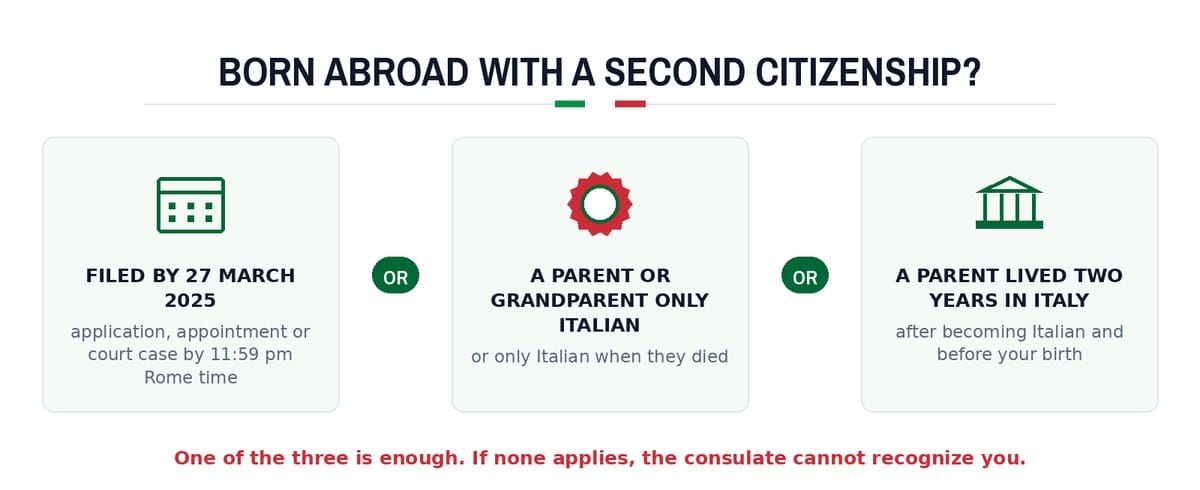
- your application was filed, or your appointment was communicated through Prenot@mi, by 11:59 pm Rome time on 27 March 2025, or a court case was filed by then;
- a parent or grandparent holds only Italian citizenship, or held only Italian citizenship when they died;
- a parent, adoptive parent included, lived in Italy for at least two consecutive years after becoming Italian and before you were born or adopted.
For most Italian Americans the deciding question is the second one. A great-grandfather who emigrated in 1905 no longer opens the door by himself: what counts is whether your parent or grandparent was Italian and nothing else.
Hear about the next passport mission
We’ll email you about upcoming passport missions and new procedure guides. No ads, and you can unsubscribe at any time.
The documents, old and new
The classic file has not gone away: the Italian ancestor's birth record from the comune, the long-form birth, marriage and death certificates of every generation down to you, each with an apostille and an Italian translation, and the proof that the emigrant did not naturalize before the next generation was born.
| Item | Detail |
|---|---|
| Law in force | Art. 3-bis, Law 91/1992 (Decree-Law 36/2025, Law 74/2025), since 24 May 2025 |
| Court ruling | Judgment 63 of 30 April 2026: challenges rejected |
| Cut-off for the old rules | 11:59 pm Rome time, 27 March 2025 |
| Fee, Oct–Dec 2026 | $691.00 (€600.00), not refunded |
| Where | The consulate that covers your address, with proof of residence |
- The Italian ancestor’s birth record from the comune
- Long-form birth, marriage and death certificates of every generation, apostilled and translated
- Proof the emigrant did not naturalize before the next generation was born
- Proof of the new condition: non-naturalization records or the certificato storico di residenza
- Application and forms 1 to 4, as your consulate asks (notarized or signed there)
- Passport copy and proof of residence in the district
- Money order or cashier’s check for $691.00 (€600.00)
The reform adds the proof of the new condition.
For an ancestor who was exclusively Italian, the consulates ask for certificates of non-naturalization from every country of emigration, or records showing that the person lived there as a foreigner; Houston also mentions negative citizenship certificates and certificates of renunciation.
Los Angeles states that self-declarations about other citizenships are not accepted.
For the two-year rule, the evidence is the certificato storico di residenza issued by the Italian comune, which shows where the parent lived and when.
How each office takes the application
Every consulate books the appointment on Prenot@mi and needs proof that you live in its district. After that the offices split in two: some want you at the counter, others want the file mailed on the day of the appointment and tell you not to come.
The fee is the same everywhere and is not refunded, whatever the outcome.
New York, San Francisco and Detroit warn that an incomplete file is rejected and that you start again with a new appointment and a new payment; the Embassy sends it back and asks for a new appointment.
If your case falls outside the new rule
One door reopened in 2026.
Judgment 24045/2026 of the Joint Sections of the Court of Cassation, and Ministry of the Interior circular 65050 of 10 August 2026, settled the so-called minor issue: someone born before August 1992 in a jus soli country to an Italian parent kept Italian citizenship even if that parent naturalized while the child was a minor, unless that person later renounced it on reaching adulthood.
San Francisco and Chicago now accept requests for reconsideration from applicants denied on that ground.
If none of the conditions applies, the consulate cannot recognize you, and a new application only costs the fee.
Two other routes may still fit: the declaration for minor children, which Italian parents can file for their own kids, and citizenship by marriage, which follows its own rules and goes through the Ministry of the Interior.
An emigrant great-grandparent is no longer enough by itself: today it takes a parent or grandparent who was only Italian, or a parent who lived two years in Italy.Official sources: New York: How to apply for citizenship by descent (iure sanguinis); Houston: Cittadinanza per discendenza (iure sanguinis); Los Angeles: Citizenship by Descent “Jure Sanguinis”; San Francisco: Citizenship; Chicago: IMPORTANTE REVISIONE DELLE LINEE INTERPRETATIVE DELL’ART. 7 DELLA LEGGE 13 GIUGNO 1912, N.555; Detroit: Citizenship by descent; Corte costituzionale, comunicato del 30 aprile 2026 (sentenza n. 63); Estratto tabella diritti consolari, 1.10–31.12.2026.
Details checked against the official pages.
italianconsulates.us is an independent guide to Italy’s consular offices in the United States. We are not the Embassy, a consulate or the Italian Ministry of Foreign Affairs.
We do not book or sell appointments: booking on Prenot@mi is free. Details are checked against the official pages and can change without notice.