
Dual nationality and the choice of nationality

A child born in the United States to a Japanese parent is very often both American and Japanese. Japanese law does not treat that as a permanent state: it requires a declaration, and the timing is set by statute.
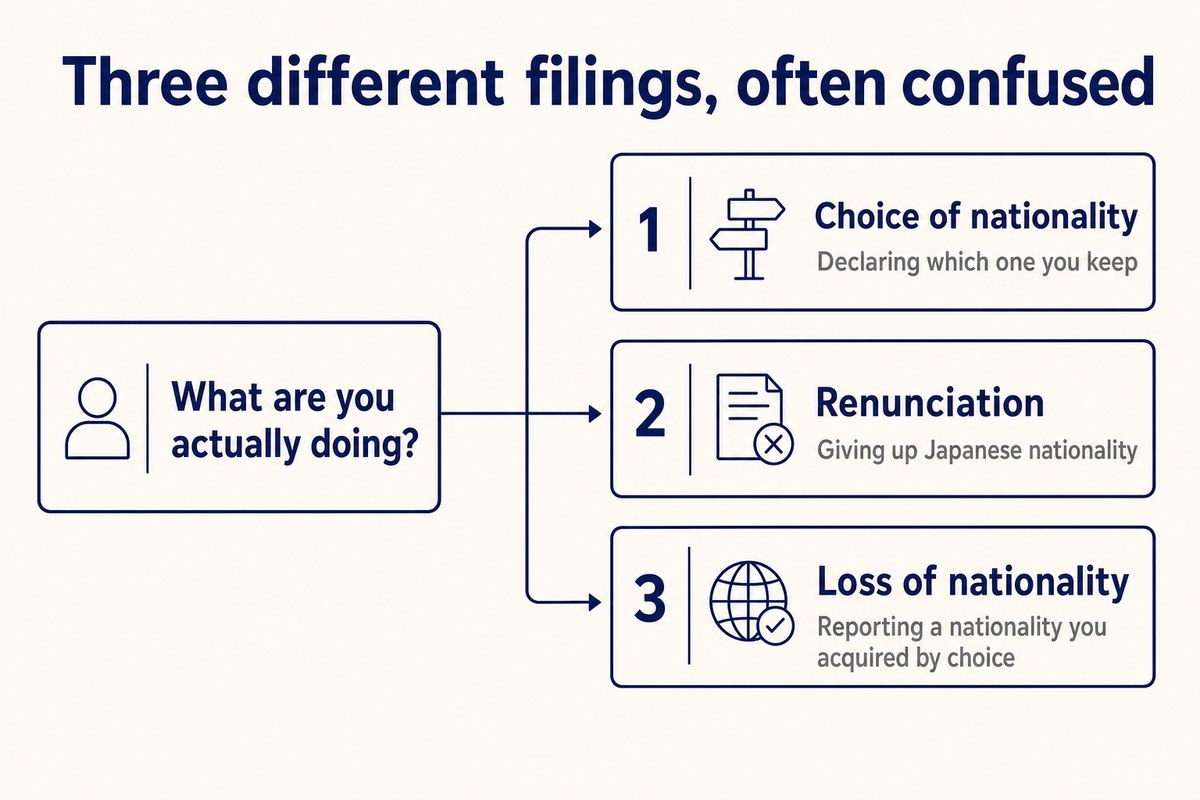
Three different filings, often confused
| Filing | What it does |
|---|---|
| Choice of nationality | Declares which nationality you are keeping |
| Renunciation | Gives up Japanese nationality voluntarily |
| Loss of nationality | Reports that you acquired another nationality by your own choice, which under Japanese law ends the Japanese one |
Where it is filed
Through the Japanese consulate that covers where you live. The declaration travels to Japan and is entered on the koseki, which again takes a month or more.
Why the dates matter more than usual
This is the area of Japanese consular law that changed most recently and the one where out-of-date advice circulates most widely. Consulate pages themselves carry different wordings. Take the deadline from the Ministry of Justice or from the consulate that covers you, and take it in writing.
How dual nationality arises in the first place
A child born in the United States to a Japanese parent is American by birth and Japanese by descent, provided the birth was registered in time with the reservation of Japanese nationality. Miss that filing and the Japanese nationality is not retained, which is the harshest deadline in this whole area.
What choosing actually involves
Declaring for Japan is a filing at the consulate that goes on the koseki. Japanese law then expects an effort to give up the other nationality, and the United States does not make that straightforward or cheap.
Declaring for Japan and renouncing U.S. citizenship are two different acts, before two different governments, with very different consequences. Take advice before either.What happens in practice
Many people in this position live for years without filing anything, and the question surfaces when they renew a Japanese passport. The consulate will tell you where you stand, and that conversation is better had early than at a counter with a flight booked.
Where to get the current rule
From the Ministry of Justice, or from the consulate that covers your state, in writing. The age of majority changed in 2022 and a good deal of the advice in circulation predates it.