
Do U.S. citizens need a visa for Japan?

This is the most asked question about Japanese consulates in the United States, and the answer is short enough that most people do not believe it. Japan and the United States have a reciprocal arrangement: you turn up with a valid passport and you are admitted for a short stay.
What the exemption covers, and where it stops
The wording the consulates use is precise. The stay must be short-term, under 90 days, and the purpose must be tourism, visiting people, business without paid activity, a conference, or study that does not stretch past the limit.
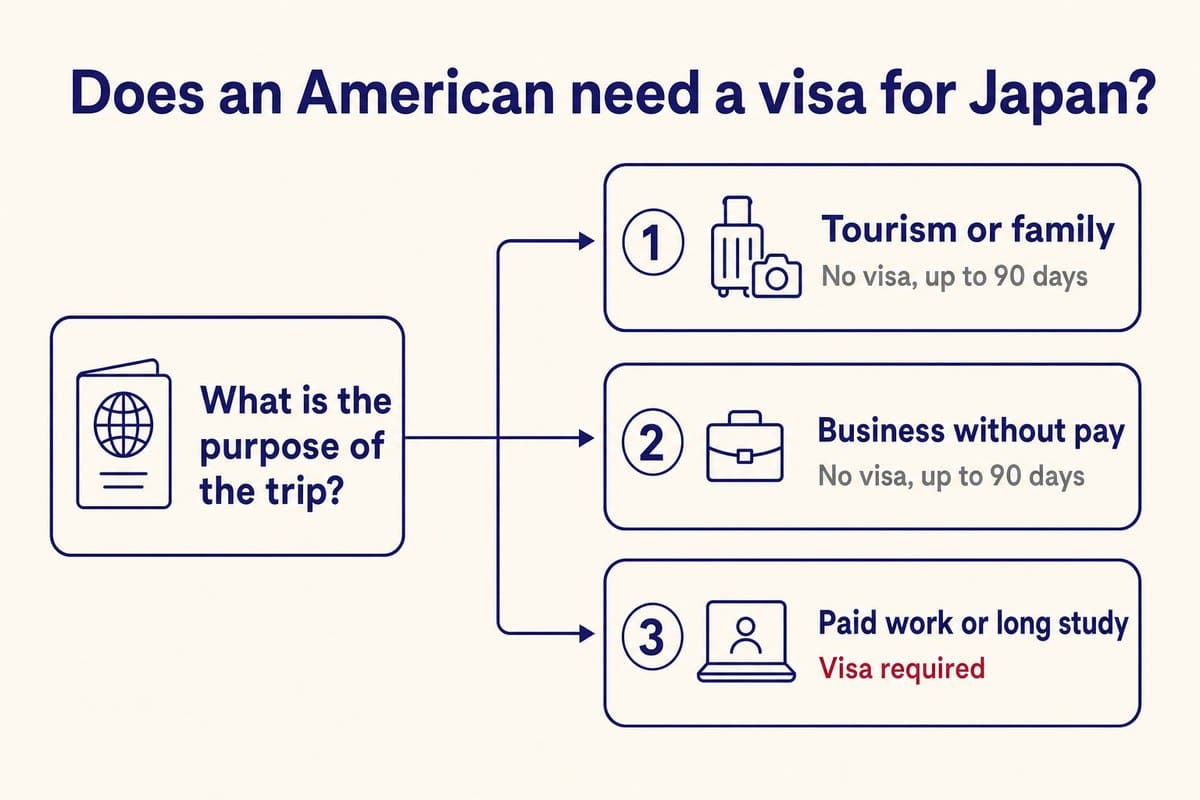
How long you actually get
Entry under the exemption is granted for up to 90 days, and the officer at the border decides the exact length. It is not automatic and it is not extendable from inside the country as a matter of course.
The 90 days are counted per entry, not per year. Leaving and returning to reset the clock is a pattern immigration officers recognise, and one that gets people turned away.
What Visit Japan Web is, and why it is not a visa
Almost every traveller now fills in Visit Japan Web before flying. It is the government portal for the immigration and customs declarations you used to complete on paper cards during the descent. It is free, it takes a few minutes, and it produces QR codes you show on arrival.
People confuse it with a visa because it is an online government form connected to entering Japan. It is not one. It does not grant permission to enter and it does not replace a visa where a visa is required.
What can still go wrong at the border
Visa-free entry is permission to ask for admission, not a guarantee of it. The officer decides. The refusals that happen to Americans cluster around three things: no onward ticket, no address in Japan, and a pattern of repeated long stays that looks like living there.
If you have spent close to half of the past year in Japan on the exemption, expect questions. The exemption is designed for visits, and immigration officers read the stamps.If you need to stay longer than 90 days
You cannot convert a visa-free entry into a longer stay from inside Japan as a matter of routine. The route is a Certificate of Eligibility obtained in Japan by whoever is sponsoring you, and then a visa at your consulate here. Start it months ahead.