
Japanese visa fees after the July 2026 revision
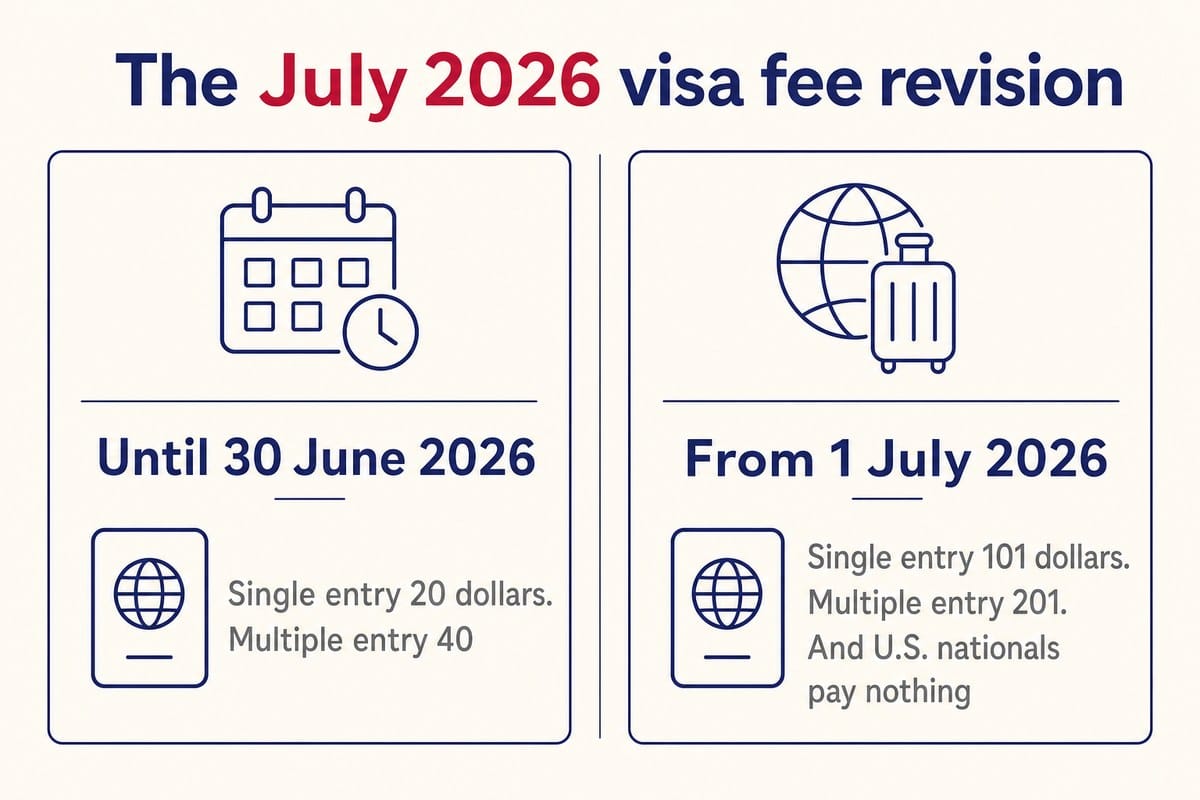
The revision was significant and it was widely reported without the second half of the sentence. Here is the table the consulates publish.
| Visa type | Until 30 June 2026 | From 1 July 2026 |
|---|---|---|
| Single entry | $20 | $101 |
| Double or multiple entry | $40 | $201 |
| Transit | $5 | Merged into single or double entry |
| Extension of re-entry permit | $20 | $20 |
| Indian passport holders | $6 | $6 |
Who pays nothing
More than sixty countries and regions are exempt from Japanese visa fees. The list includes the United States and Canada, most of Europe, Australia and New Zealand, and a number of countries in Latin America and Asia.
How you pay, when you pay
The route decides the method. In person or by post, cash only and in the exact amount: several consulates give no change, and reviewers describe losing half an hour hunting for the right notes. Through the eVISA, card only. Personal cheques are not accepted anywhere.
Applications that were complete on or before 30 June 2026 kept the old fee even where the visa was issued later. Files that arrived incomplete did not.
Why the exemption exists
Visa fee exemptions are reciprocal arrangements between governments. Japan does not charge nationals of countries that do not charge Japanese nationals, and the list is long: most of Europe, Australia and New Zealand, Korea, Malaysia, Pakistan, Bangladesh, and a series of countries across Latin America.
The exemption is from the fee, not from the visa. Where a visa is needed, an exempt national still applies, still supplies the file and still waits. They simply do not pay.
The Indian passport line in the table
Every consulate's fee table carries a separate row for Indian passport holders at six dollars, unchanged by the July 2026 revision. It is a long-standing bilateral arrangement and it surprises people reading the table for the first time.
What the fee does not cover
The visa fee is not the cost of the trip's paperwork. A Certificate of Eligibility, a translation, a photo and courier postage all sit outside it, and together they usually cost more than the visa.And for services other than visas, the fees are set separately and published by each office, sometimes as an image rather than as text. Ask the office that covers you rather than relying on a figure copied from a directory.